Van der Valk Hotels
•
Europe
How Van der Valk Hotels scaled a 75-hotel portfolio with one cloud-native PMS

Area of operation
Number of properties
Number of rooms
Accommodations
Museums
Attractions
Catering establishments
For years, Van der Valk relied on a legacy PMS that could no longer support the group's future growth. With 75 hotels operating under one brand, each with its own local character, technology stack, and way of working, the challenge was about more than replacing software. The group needed a platform that could bring greater consistency, scale across the portfolio, integrate with existing systems, and support diverse operational requirements without forcing a one-size-fits-all approach.
This case study explores how Van der Valk Hotels transitioned to Shiji Daylight PMS, a modern cloud-native platform that enabled stronger collaboration, standardized operations, and long-term scalability. It examines how a unified PMS can support a hotel group where every property retains its own identity, the role of cloud-native architecture in scaling across a large portfolio, and how an open integration ecosystem enhances operational flexibility.


Objective and methodology
Van der Valk set out to implement a platform capable of supporting both current operations and future innovation. Scalability, open integrations, and cloud-native infrastructure were essential requirements, alongside deep support for Meetings & Events, a key part of the business.
The rollout was approached as a transformation program rather than a traditional IT project.
A pilot phase played a critical role. By investing time upfront, the team was able to test, learn, and refine the implementation model before scaling. This allowed them to build a repeatable rollout approach that could be applied across dozens of hotels.
As deployment progressed, each implementation improved the next. Lessons from real operational use fed directly back into the process, accelerating adoption while reducing friction.
Building confidence through validation
Before moving into a wider rollout, Van der Valk invested heavily in technical and operational validation. The assessment focused on platform architecture, security, privacy, integrations with the Valk ecosystem and the ability to support complex hotel operations, including Meetings & Events. This rigorous evaluation process helped create alignment across the organization and ensured confidence in the selected platform before full deployment.

“The goal was never simply to replace a PMS, but to create a platform that hotels would genuinely want to build their future on.” — Joris Landa, Operations Director, Van der Valk Hotels
The transformation
What started as a technology replacement quickly became a broader operational transformation.
As hotels moved onto Shiji Daylight, teams gained access to a centralized platform instead of working across disconnected systems and property-specific workflows.
For corporate stakeholders, this created greater consistency in data and reporting across the portfolio.
For individual hotels, it meant they could continue using critical operational tools while connecting them through a common PMS platform.
Perhaps most significantly, the organization shifted from working around the limitations of legacy systems to operating on a modern platform designed for continuous evolution. Rather than forcing hotels to abandon the tools they relied on, Shiji Daylight's open architecture allowed properties to maintain established workflows and specialized capabilities while benefiting from a shared, cloud-based platform across the group.
“The technical assessment was deliberately broader than selecting a PMS. We looked at architecture, scalability, security, privacy, integrations with the Valk Platform, and how the system would perform in daily hotel operations. That gave us the confidence that Shiji Daylight could become a future-proof foundation for the group.” — Jorrin Geurts, Van der Valk
The results
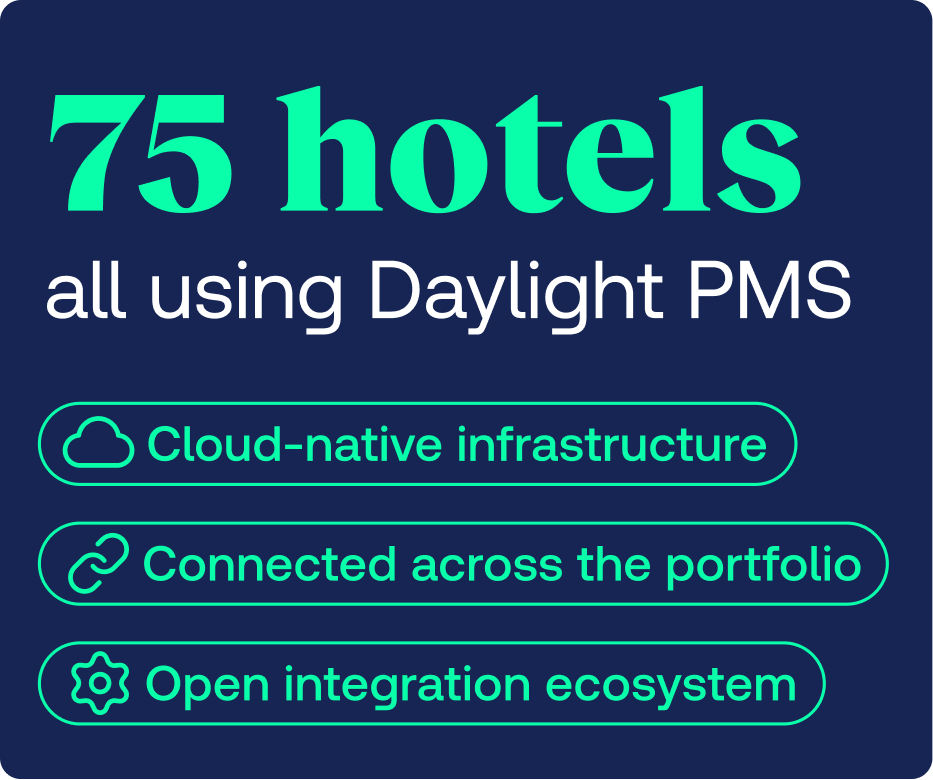
The project delivered far more than a PMS replacement. Van der Valk established a unified digital foundation across 75 hotels, eachwith its own local identity, bringing teams onto a single cloud platform with shared workflows, standardized data, and a common source of truth.
Strong user adoption was a key success factor, with Shiji Daylight PMS enabling rapid onboarding, minimal training requirements, and consistent use across properties. The rollout also evolved into a scalable deployment model, supporting future growth while preserving flexibility through an open integration ecosystem.
The result is a more connected operation, improved collaboration across hotels, and a platform that enables Van der Valk to continuously innovate and deliver consistent guest experiences.
“What makes me most proud is not the technology itself, but the collaboration behind it. Our central teams, the hotel teams and Shiji worked as one project team, continuously testing, improving and learning together. That partnership enabled us to roll out a shared platform while preserving the entrepreneurial spirit that makes every Van der Valk hotel unique.” — Joris Landa, Operations Director, Van der Valk Hotels
Conclusion
For many hotel groups, replacing a PMS is a necessary upgrade.
For Van der Valk, it became something more meaningful:they didn’t just change systems, they aligned an entire organization around ashared digital future.
By carefully balancing standardization with local character, they proved that even the most distinctive, locally-run hotel portfolios can work from a common foundation, without losing what makes each property unique.
Just as importantly, the relationship between Van der Valk and Shiji has moved beyond a traditional vendor model, evolving into atrue partnership that actively drives innovation across the business.
Van der Valk Hotels
Van der Valk Hotels is a family-run hospitality group with 75 hotels across Europe, each with its own local identity. Known for combining strong local character with high operational standards, the group serves both leisure and business travelers, with a particular strength in Meetings & Events.
By embracing a shared digital platform while preserving entrepreneurial independence, Van der Valk continues to evolve as one of Europe’s most distinctive hotel brands.
About Shiji Group
Shiji is a global technology company dedicated to providing innovative solutions for the hospitality industry, ensuring seamless operations for hoteliers day and night.
Built on the Shiji Platform—the only truly global hotel technology platform—Shiji’s cloud-based portfolio includes Property Management System, Point-of-Sale, guest engagement, distribution, payments, and data intelligence solutions for over 91,000 hotels worldwide, including the largest chains.
With more than 5,000 employees across the world, Shiji is a trusted partner for the world’s leading hoteliers, delivering technology that works as continuously as the industry itself. That’s why the best hotels run on Shiji—day and night. While its primary focus is on hospitality, Shiji also serves select customers in food service, retail, and entertainment in certain regions.For more information, visit shijigroup.com
More case studies

Van der Valk Hotels
How Van der Valk Hotels scaled a 75-hotel portfolio with one cloud-native PMS

APA Hotel Woodbridge
How an independent New Jersey hotel moved beyond 15 years of legacy systems with Shiji
.jpg)

The Belfry Hotel & Resort
Evaluating digital payment transformation at The Belfry


Sunborn London